
Criminal Justice

Major, Minor

The School of Education and Human Services

From prosecuting a witness in a mock trial to analyzing evidence with state-of-the-art forensic technology to investigating a staged crime scene, Quincy University has the tools for success in criminal justice.
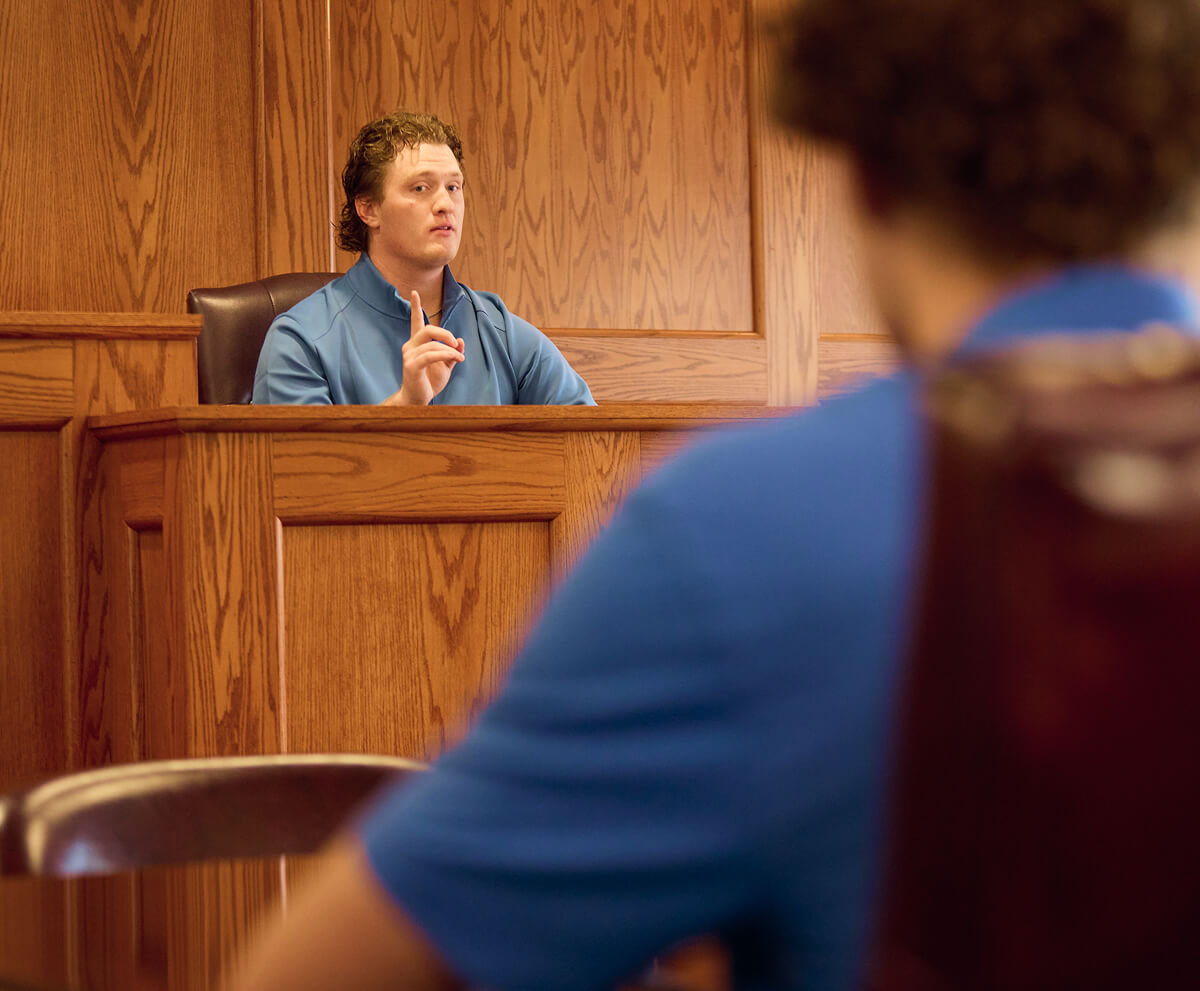

Behind the shoulder shot of student on witness stand in a mock trial

Opportunities & Outcomes

The Criminal Justice curriculum combines faculty expertise with hands-on learning and specialized technology to prepare students for professional roles in the justice system. Students study criminology, crime analysis, and the causes and impacts of crime, building the knowledge and skills needed to serve effectively in law enforcement, courts, and community-based justice roles.

Career Pathways

Law Enforcement & Public Safety

  • Police officer or deputy sheriff
  • State or federal law enforcement roles
  • Campus or community safety officer
  • Crime prevention or community policing specialist

Courts, Legal & Judicial Services

  • Court clerk or judicial assistant
  • Legal assistant or paralegal
  • Probation or parole officer
  • Victim advocacy or court services coordinator

Corrections & Rehabilitation

  • Corrections officer or supervisor
  • Case manager or rehabilitation program assistant
  • Reentry or offender services coordinator
  • Juvenile justice support roles

Federal, State & Local Government

  • Federal agencies (e.g., homeland security, investigations)*
  • Intelligence or policy analysis support roles
  • Regulatory or compliance positions
  • Public administration or civil service careers

Nonprofit, Advocacy & Community Service

  • Victim services or advocacy specialist
  • Community outreach or prevention coordinator
  • Social justice or nonprofit program staff
  • Youth or restorative justice program coordinator

Graduate & Professional Pathways

  • Graduate study in criminal justice, criminology, or public administration
  • Law school or legal studies programs*
  • Social work, counseling, or public policy graduate programs
  • *Additional certification, training, or graduate study may be required for some roles.

Programs of Study Offered

  • Bachelor of Science in Criminal Justice
  • Criminal Justice Minor

Learning by Doing

Active Learning Opportunities and Clubs

Attend court proceedings at the federal court in Quincy and watch real trials or join the Quincy University mock trial team and participate in competitions.

Internships in Criminal Justice

Paid internship opportunities with several local Quincy government departments, including the police and probation departments.

Center for Legal Studies

The Center for Legal Studies supports students through hands-on learning in mock trial, legal analysis, and forensic investigation, preparing them for law school and careers in law, criminal justice, and related fields. The center includes the John “Pete” Brown Courtroom, classrooms, conference rooms, a computer lab, and a law library.

Faculty Spotlight

Judy Abbott, JD

Judy Abbott, JD

Assistant Professor of Criminal Justice

Brian Borlas, PhD

Brian Borlas, PhD

Professor of Political Science

Jamie Friye, JD

Jamie Friye, JD

Adjunct Assistant Professor of Criminal Justice

James Palmer, JD

James Palmer, JD

Adjunct Professor of Criminal Justice and Political Science

Samuel Tedrow, MA

Samuel Tedrow, MA

Adjunct Instructor of Criminal Justice

Bonaventure Program

Every QU student’s foundation for our liberal arts education, involving service learning, signature courses, writing, technological literacy. Program Requirements

Take the Next Step