
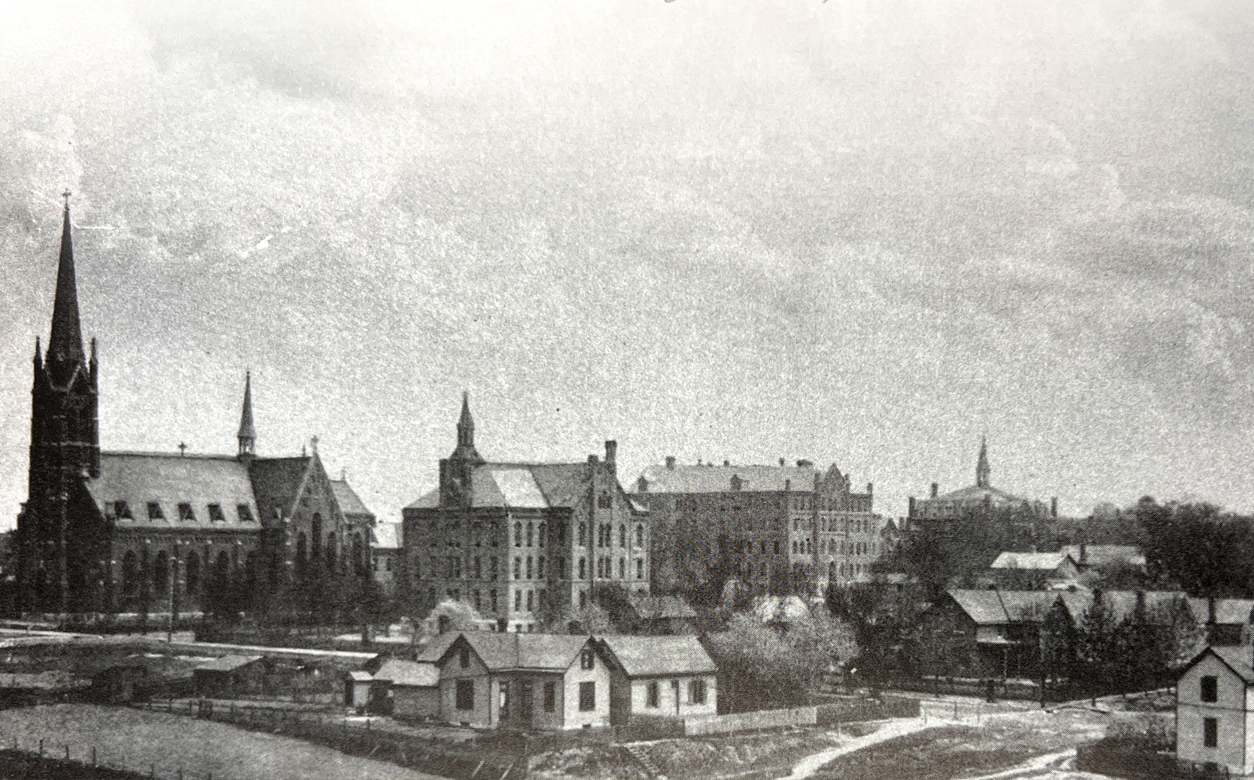
A Legacy of Learning and Service
History of Quincy University
Quincy University’s story begins on February 6, 1860, when Franciscan friars opened St. Francis Solanus College in Quincy, Illinois. From its earliest days on 8th and Maine Street, the institution grew steadily—moving into what is now the eastmost wing of Francis Hall in 1871 and receiving an Illinois charter in 1873 to grant academic degrees.
In 1878, Father Augustus Tolton—who would become the first Black priest in the United States—entered the College as a student, marking a significant moment in Quincy University’s history. Tolton’s story—marked by perseverance, faith, and a commitment to service—continues to inspire the Quincy community and reflects the University’s mission and Catholic identity.
In 1904, Salvatore Giuseppe Riggitano—the paternal grandfather of Robert Francis Prevost, who would later become Pope Leo XIV—attended St. Francis Solanus College, marking another historic moment for Quincy.
Growth, change, and Campus Life
Over time, Quincy University expanded its programs, campus life, and community impact. In 1917, the institution became Quincy College and Seminary, reflecting its evolving identity and mission. In 1926, the City of Quincy renamed Vine Street to College Avenue, reflecting the growing presence of the University and its long-standing connection to the surrounding neighborhood. Campus traditions and student life developed through milestones like the launch of The Falcon student newspaper in 1929, and in 1932, women were first admitted as full-time day students.
The mid-20th century brought major growth and lasting foundations. During World War II, enrollment shifted dramatically, and the University supported the national effort by training naval cadets and army reservists. In 1948, the Quincy College Foundation was created, laying groundwork for endowment and long-term sustainability. QU achieved initial accreditation in 1954 through the North Central Association (now the Higher Learning Commission).
As the campus expanded, so did student opportunities. Facilities such as Brenner Library (1967) and the University’s first computer purchase in 1969 marked new eras of learning and innovation. Athletics and the arts grew into signature parts of the QU experience—from championship soccer traditions beginning in 1966 to major performing arts milestones such as the opening performance at Machugh Theatre in 1965.
Becoming Quincy University
In 1993, the institution officially became Quincy University, a name that honors its Franciscan heritage while reflecting continued growth and momentum. In the years that followed, QU advanced in key ways—expanding technology resources, strengthening student life, and investing in campus facilities. The University marked a major milestone with its 150th anniversary in 2010, and recent years have brought transformative philanthropic support for scholarships, academic programs, and student success, including the naming of the Oakley School of Business in 2021 following the largest single philanthropic investment in University history. In 2024, QU dedicated the Ryan Center for Science at the North Campus, made possible through a generous donation that continues to advance hands-on learning and innovation for students.
Looking Ahead
Building on more than a century and a half of progress, Quincy University continues to expand opportunities for students through meaningful experiences in learning, leadership, and service. With ongoing investment in academic excellence, career readiness, and student support, QU will strengthen the programs and resources that help students thrive in and beyond the classroom. Grounded in our Catholic and Franciscan identity, we will grow with purpose, respond to a changing world, and prepare graduates to lead lives of service and impact.